Loading...
Serving Easton, MA and surrounding areas. (774) 568-8870
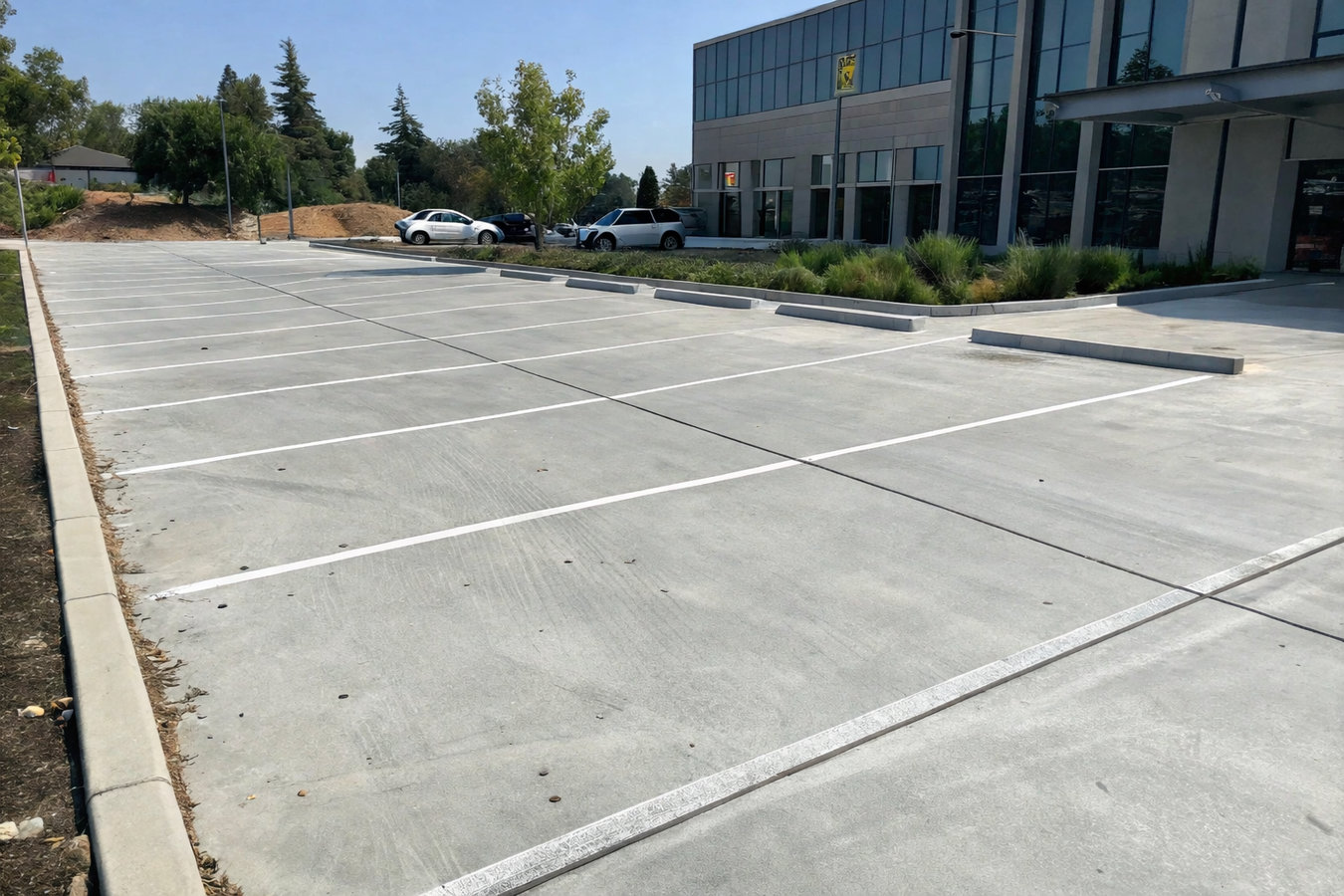
Gravel turns to mud every spring and asphalt breaks down fast in New England winters. We build concrete parking lots in Easton with the right base, drainage, and mix to survive freeze-thaw cycles year after year.
Concrete parking lot building in Easton means removing the existing surface, excavating and grading the site for proper drainage, compacting a crushed stone base, and pouring a reinforced concrete slab with control joints - most residential-scale lots take three to five days of active work plus at least one week of curing before the surface can handle vehicle traffic.
A lot of Easton property owners reach this decision after years of dealing with a gravel area that becomes a mud pit every March, or an aging asphalt surface that has been patched so many times that another patch no longer makes financial sense. Concrete is a longer-term investment - it costs more upfront than asphalt but routinely lasts two to three times as long in a New England climate when it is built correctly.
If your project also involves a new driveway connecting to the lot, our concrete driveway building service can be coordinated alongside the parking area so the drainage and grade are designed as one system rather than two separate projects.
If you walk your parking area in spring and find cracks that were not there last fall, or sections that have pushed up or sunk down, that is freeze-thaw damage at work. In Easton's climate, where temperatures swing above and below freezing throughout winter, this kind of damage compounds year over year. At some point, patching stops making financial sense and a full replacement is the better investment.
Standing water after a rainstorm means your surface is no longer draining correctly - either because it has settled unevenly or was never graded properly to begin with. In Easton, heavy spring rains and snowmelt make pooling a regular problem. Pooled water accelerates surface damage, and on a business property it creates a slip hazard. A properly graded replacement solves this for good.
Easton's spring thaw can leave unpaved areas unusable for weeks. If your gravel parking area develops ruts, turns muddy, and tracks into the house or garage every March and April, that is a recurring problem with a permanent fix. Converting to concrete gives you a clean, stable surface that stays accessible through mud season and requires almost no ongoing maintenance.
If you have built or are planning a garage, workshop, or commercial outbuilding, this is the right time to do the parking area alongside it. Combining site work saves on mobilization costs and ensures drainage is designed as a single system. Trying to add a paved surface after the fact often means disturbing completed landscaping and grading that was already done correctly.
Every parking lot project we build includes the full scope: site excavation to the right depth, grading for positive drainage away from buildings, a compacted crushed stone base, and a reinforced concrete slab with properly spaced control joints. We do not skip the base preparation - that step is what determines whether the slab holds up for 30 years or starts cracking in five. We also handle permit coordination with the Town of Easton Building Department and can advise on stormwater requirements that apply to larger or wetland-adjacent lots. For properties that also need improved surface access from the street, we often pair this work with our concrete driveway building service so both surfaces are graded as one drainage system.
For projects that also involve structural work below grade - new footings for a garage or outbuilding on the same parcel - our concrete footings service can be scheduled alongside the parking lot work so the site is excavated and disturbed only once. Coordinating both reduces cost and avoids having to re-grade a freshly finished lot when the footing crew arrives later.
Best for converting a gravel, dirt, or grass area to a permanent paved surface for the first time, whether residential or small commercial.
Best for removing a failed asphalt or deteriorated concrete surface and starting fresh with a properly designed slab and drainage plan.
Best for adding parking capacity to an existing lot where additional space is available and needs to be integrated with the current surface and drainage.
Best for new construction projects where the parking lot, driveway, and access surfaces are all being built at the same time and can share one mobilization and drainage design.
Easton sits in a climate zone where temperatures regularly cross the freezing mark multiple times throughout winter. Every freeze-thaw cycle puts stress on any surface that holds water or has small voids where moisture can settle. The soil underneath adds another variable - much of Easton sits on glacially deposited material, a mix of sandy loam, gravel, and in some spots pockets of clay or organic fill from the last ice age. Clay and organic soils compress and shift under load, so the base layer beneath your lot has to be assessed and designed for what is actually in the ground on your specific parcel, not just built to a standard spec from somewhere warmer. Massachusetts also has detailed stormwater requirements for impervious surfaces, and with several protected wetland areas in and around Easton - including the Hockomock Swamp wildlife management area to the west - some projects near those boundaries need a stormwater review before permits are issued. A contractor who knows this area will flag that upfront rather than letting you discover it after work has already started.
Homeowners in Taunton and Mansfield face similar conditions - the same glacial soils, the same freeze-thaw exposure, and the same Massachusetts permitting requirements. We work throughout the region and bring that consistent local knowledge to every project regardless of which town the lot is in.
We visit your property, take measurements, look at the site conditions, and give you a written estimate that breaks down site prep, materials, and labor. We will also tell you upfront whether your project needs a town permit and whether stormwater review applies. You will hear back within one business day of your initial contact.
Once you approve the estimate, we handle the permit application with the Easton Building Department. Permit review typically takes one to three weeks. We confirm your start date as soon as the permit is approved so you are not left waiting without a timeline.
The crew removes the existing surface, excavates to the correct depth, grades the area for drainage, and compacts a crushed stone base. This phase typically takes one to two days and is the most critical part of the project - the base is what the slab sits on for the next three decades.
Forms are set, concrete is poured and finished in a single day for most residential-scale lots, and the surface must cure for at least seven days before vehicle traffic. At the final walkthrough we confirm drainage is working correctly and give you written guidance on sealing and first-winter care.
We visit your site, walk you through the options, and give you a written estimate - no obligation and no sales pressure.
(774) 568-8870We specify air-entrained concrete mixes formulated for cold-climate performance - the same type recommended by the American Concrete Pavement Association for surfaces exposed to repeated freezing and thawing. A standard mix poured in Easton will degrade faster than a properly specified cold-climate mix - and once the surface is down, you cannot change the mix.
We visit your property before giving you a price - not after. Easton's soil varies from sandy glacial deposits to clay-heavy areas where drainage needs extra design attention. A contractor who quotes over the phone without seeing the ground is guessing at the base design, and you are the one who lives with the result.
We coordinate every permit with the Easton Building Department and handle the inspection scheduling so you are not managing paperwork while we are managing the job. Permitted work is on record - that matters when you sell your property or file an insurance claim and someone asks for documentation.
One of the most common complaints after a parking lot project is water running toward the house or pooling in the wrong places. We review the drainage plan before any excavation starts - because fixing a drainage problem after the concrete is down means tearing out work that was just completed.
The combination of cold-climate mix specification, on-site assessment, proper permit handling, and drainage design upfront is what separates a lot that holds up through 30 Easton winters from one that needs patching by year three. Every one of those steps matters, and none of them are negotiable on our jobs.
When your new lot also needs a garage or outbuilding built alongside it, proper footings below the frost line are the first structural step.
Learn MoreConnect your new parking area to the street with a driveway built on the same drainage system for a seamless finished result.
Learn MoreSpring slots fill fast - call or submit a form today to lock in your start date before the season books up.